

Approach
We think before we act
Our work begins with inquiry rather than assumption. Across wealth management, accounting and taxation, and business advisory, the right answer to a client’s problem is rarely the obvious one. Finding it requires the discipline to question what appears certain — and the rigour to keep questioning until the evidence points somewhere trustworthy.
That discipline turns a certainty into a question: “I am right” becomes “how do I know I am right?”
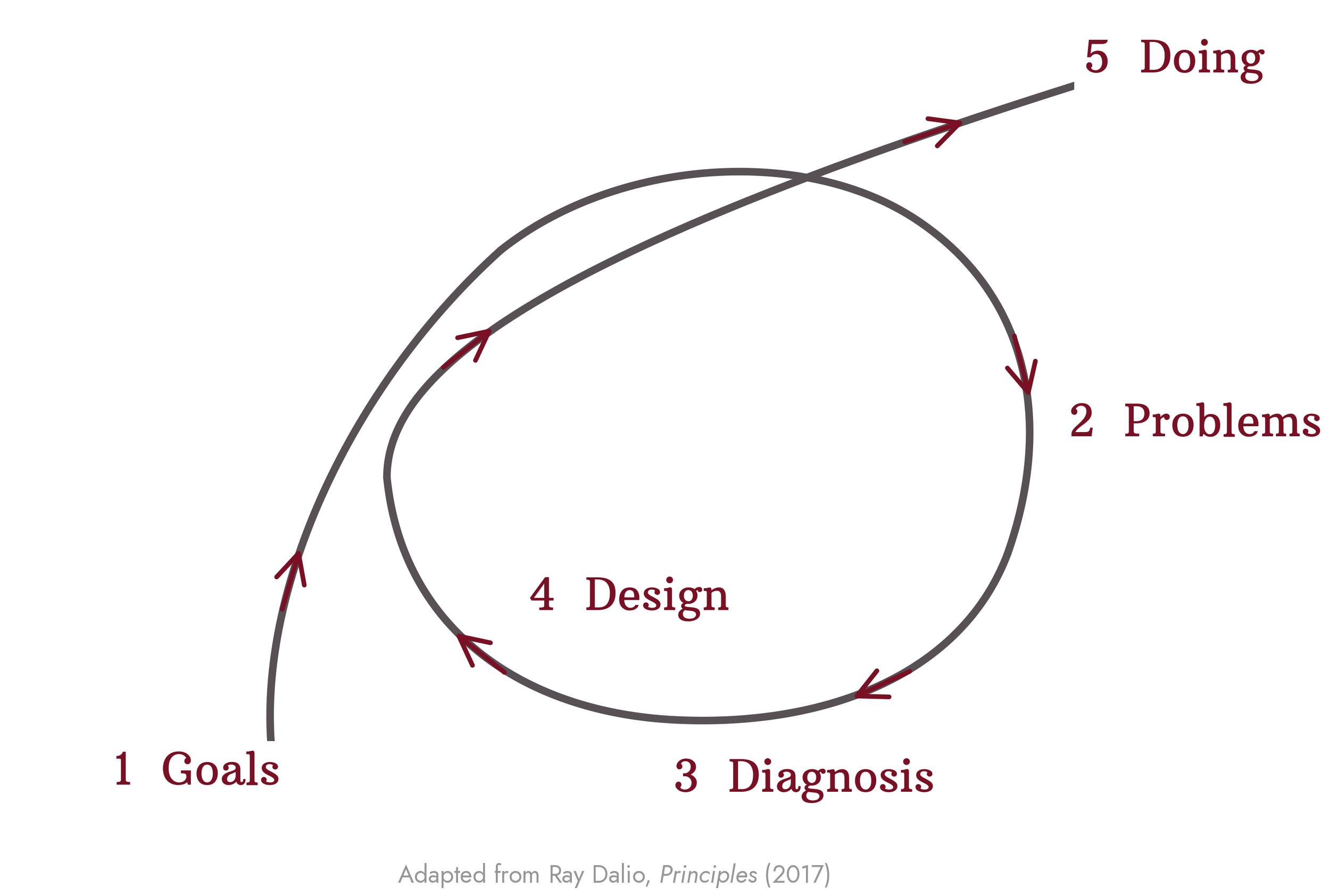
We apply it through five steps, adapted from the framework Ray Dalio sets out in Principles (2017).
The five steps
Step 1 — Goals
Clarity begins here. Before we can help a client move forward, we need to understand precisely where they want to go — with the specificity that makes a strategy meaningful, rather than in general terms. A goal that is vague produces a strategy that is vague, and a strategy that is vague produces an outcome that is accidental.
Step 2 — Problems
Once the goals are clear, the obstacles become visible. This step requires honesty — from us and from the client. Financial challenges, structural constraints, behavioural patterns, missed opportunities. We name them plainly, because a problem that is not named cannot be solved.
Step 3 — Diagnosis
Identifying a problem is not the same as understanding it. This step goes deeper — to the root causes beneath the surface symptoms. Most financial difficulties are not what they first appear to be. A cash flow problem may be a pricing problem. A tax problem may be a structure problem. An investment underperformance may be a behaviour problem. Accurate diagnosis is the difference between treating symptoms and solving problems.
Step 4 — Design
With the goals defined, the problems identified, and the root causes understood, we design the strategy. This is where our three divisions work in concert — wealth management, accounting and taxation, and business advisory — because the whole picture demands a whole answer. Every element of a client's financial life is considered alongside every other. The result is a strategy that is specific, coherent, and executable.
Step 5 — Doing
Until it is implemented, a strategy remains a document. This final step is where intention becomes action — and where our ongoing involvement matters most. We implement, monitor, review, and adapt. As circumstances change, the strategy evolves. The five steps do not end here. They begin again, at a higher level of understanding, informed by everything that has been learned.
If this reflects how you think about your financial affairs, we would welcome a conversation.